Solutions

Capabilities we bring to every machine.

A small set of reusable foundations — hardware bricks, indexed inventory, a CODESYS controls template, and integrated fixtures — that travel with every Levra build. Each project sharpens the library, so the next machine ships faster.

01 / Modular bricks

Hardware patterns that travel between projects.

Bricks are the internal patterns we trust: controls, motion, pneumatic, and power modules we re-use across builds. They let us mock up a cell on the bench quickly, prove out the design with real hardware, and iterate without rebuilding the panel between revisions.

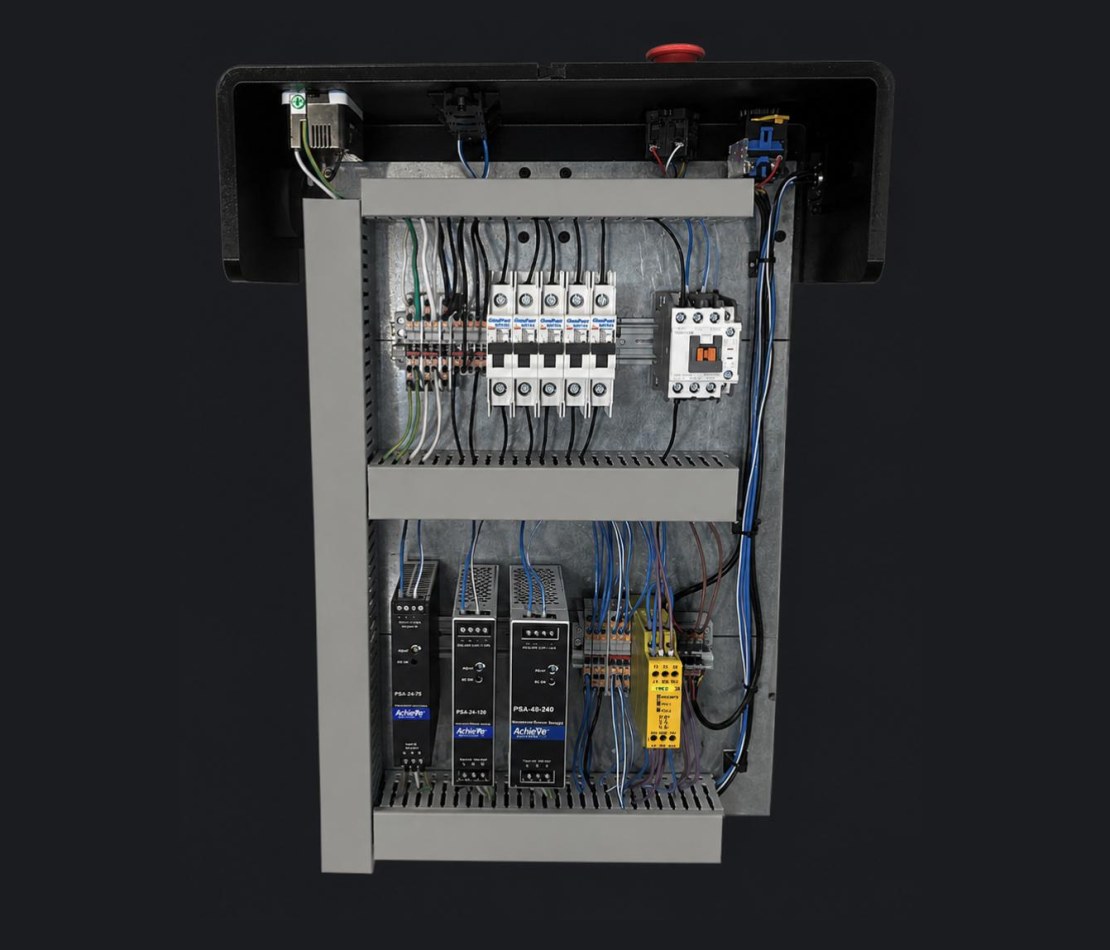
When your machine ships, it doesn’t carry the bench rack. You get a custom industrial control panel using only the components your build actually needs — the same proven parts we developed on, laid out for production.

  • Power brick. AC input converted to 24V and 48V DC rails with a built-in E-stop and safety relay. The clean-power foundation under every panel.
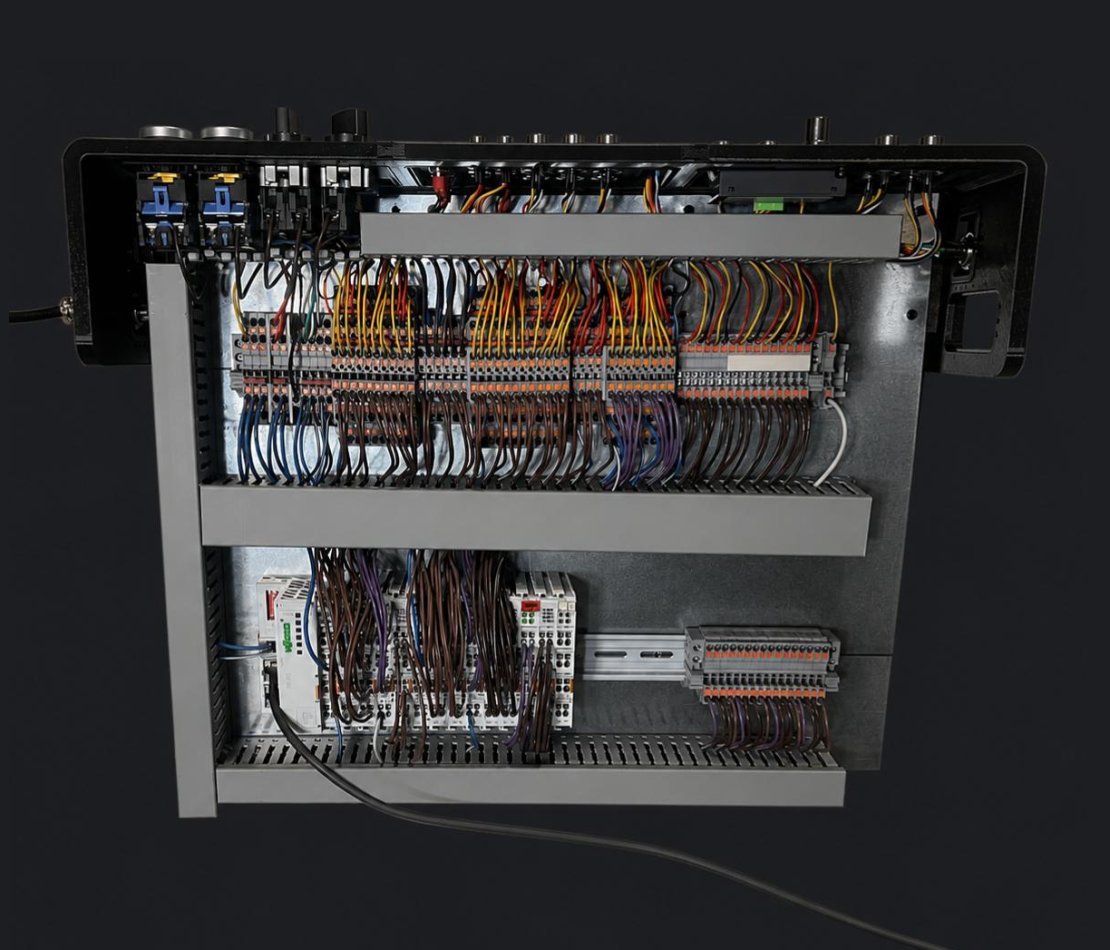
  • Controls brick. PLC or soft-PLC, digital and analog I/O, and communication modules. Signal outputs to the motion and valve manifold.
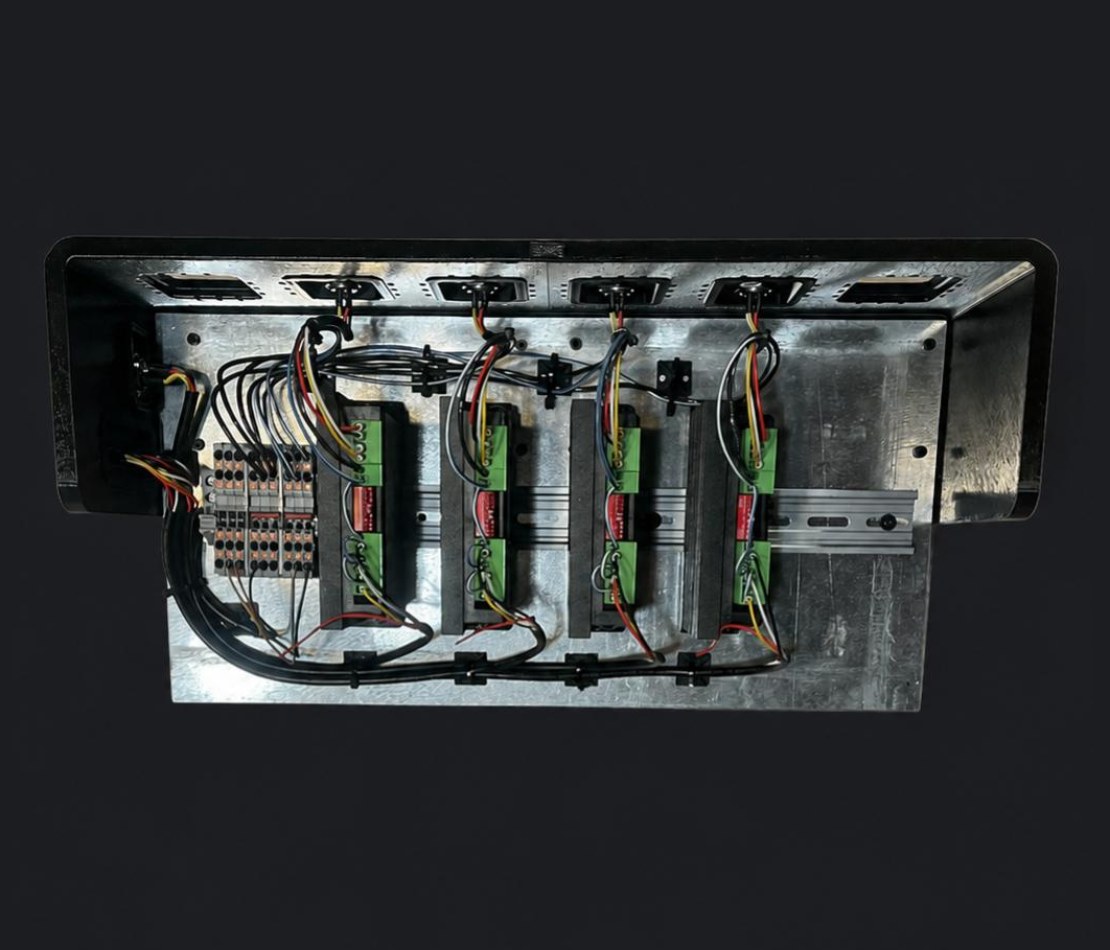
  • Motion brick. Stepper and servo drives for axes, gantries, and rotary stations. Tuned, labeled, and field-replaceable.
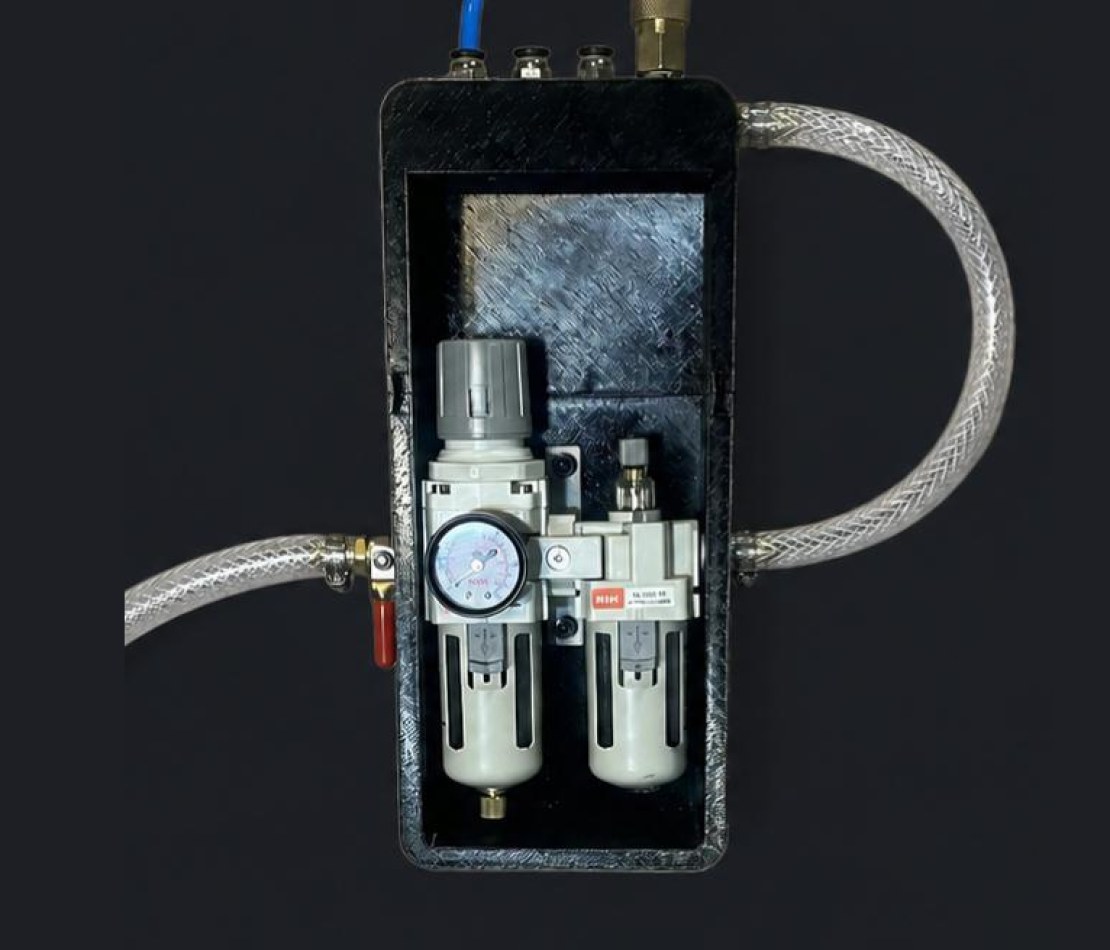
  • Pneumatic brick. Filtered air supply feeding a valve manifold; solenoid valves driven via a DB-25 cable from the controls brick. The actuation layer for clamps, ejects, and cylinders.

Why bricks pay off

  • Faster proof-of-concept — mock up the cell on a bench in days, not weeks.
  • Predictable BOMs — re-used parts mean fewer surprises in procurement.
  • Validated components in production — the same parts proven on the bench show up in your custom industrial panel, so there’s no surprise compatibility at integration.
  • Software side handled by the CODESYS template — the two foundations work together.
02 / Hardware inventory & pick lists

An organized shop, not a stockpile.

Every component scanned, indexed, and tied to a project. Pick lists and build instructions generated per build. The shop runs like a small manufacturer, not a small studio — parts pulled from labeled bins, not hunted across vendors.

The full workflow chain

Every link is auditable. From spec to assembly, you know exactly which parts went into which machine and why.

Step 1

Project spec

Cell requirements, parts list, and station definitions captured up-front in one place.

Step 2

BOM

Bill of materials with vendor part numbers, quantities, and approved substitutes called out.

Step 3

Pick list

Allocation pulled from inventory. Gaps flagged for ordering before the build starts.

Step 4

Kit pulled

Complete kit assembled on the bench before any build begins. No scavenger hunts on assembly day.

Step 5

Guided assembly

Mount, wire, and plumb each device with show-on-diagram views guiding every connection.

Step 6

Checkout

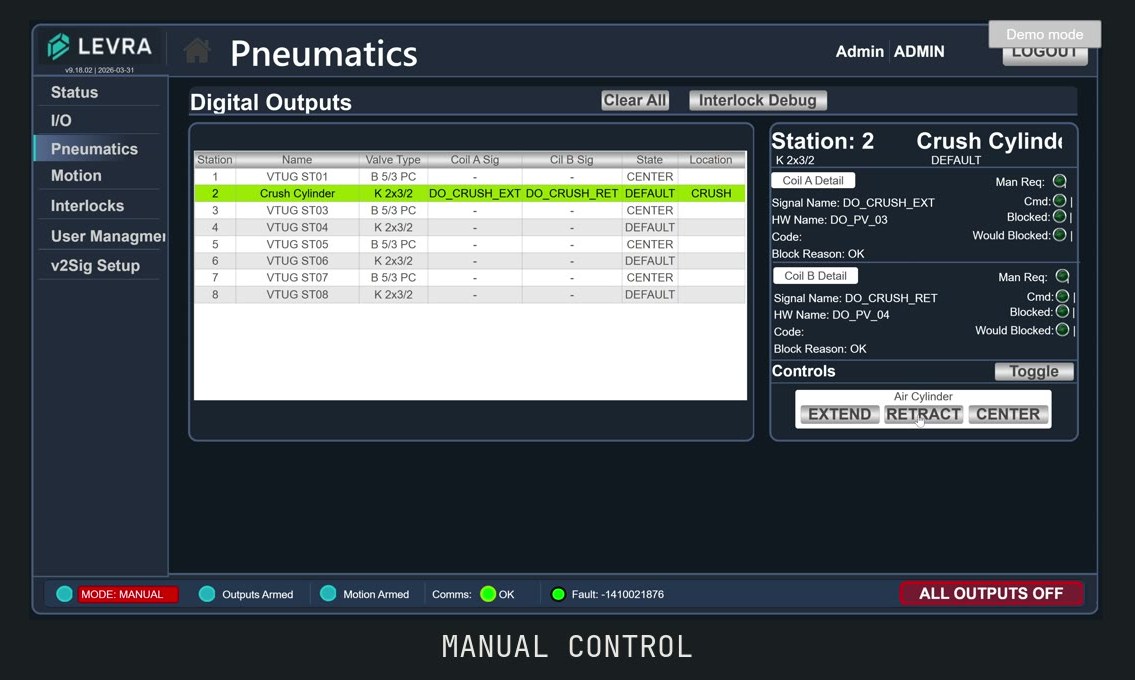
Operator verifies every actuator and sensor in the CODESYS template’s manual HMI.

  • Parts on the shelf when you need them. No three-week pauses waiting on a missed line item.
  • Cleaner change orders. When you change a spec mid-build, we know exactly which parts are affected and what the cost delta is.
  • Discipline that scales. Works for one machine. Works for several in parallel.
03 / The Codesys template

A reusable controls foundation under every build.

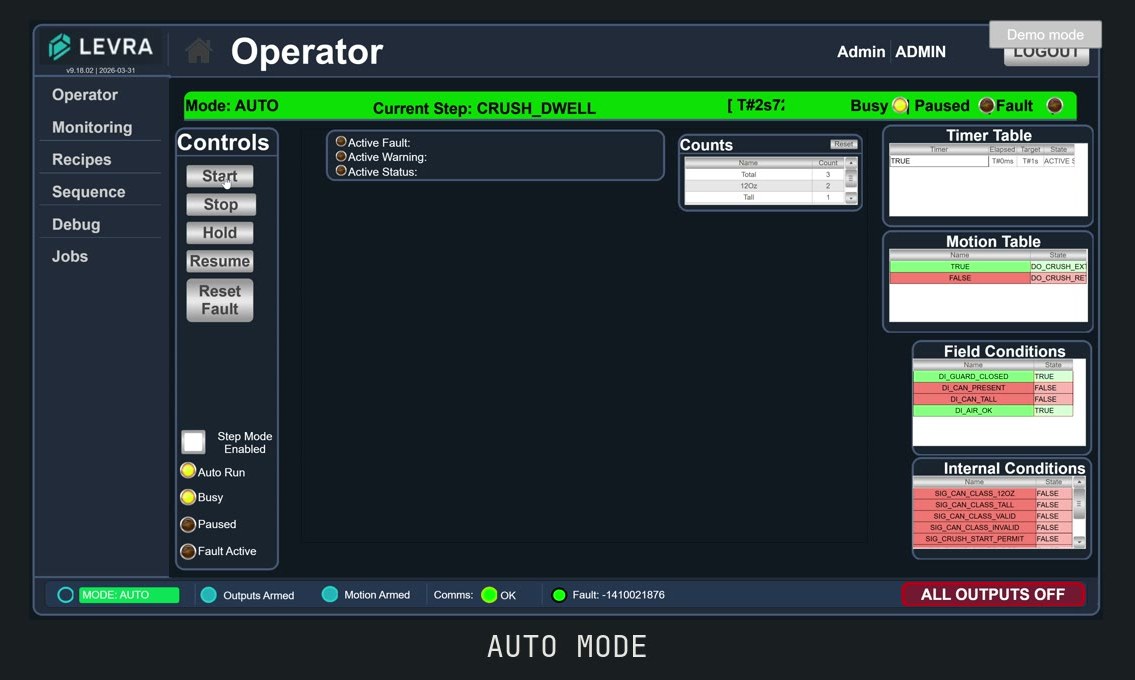
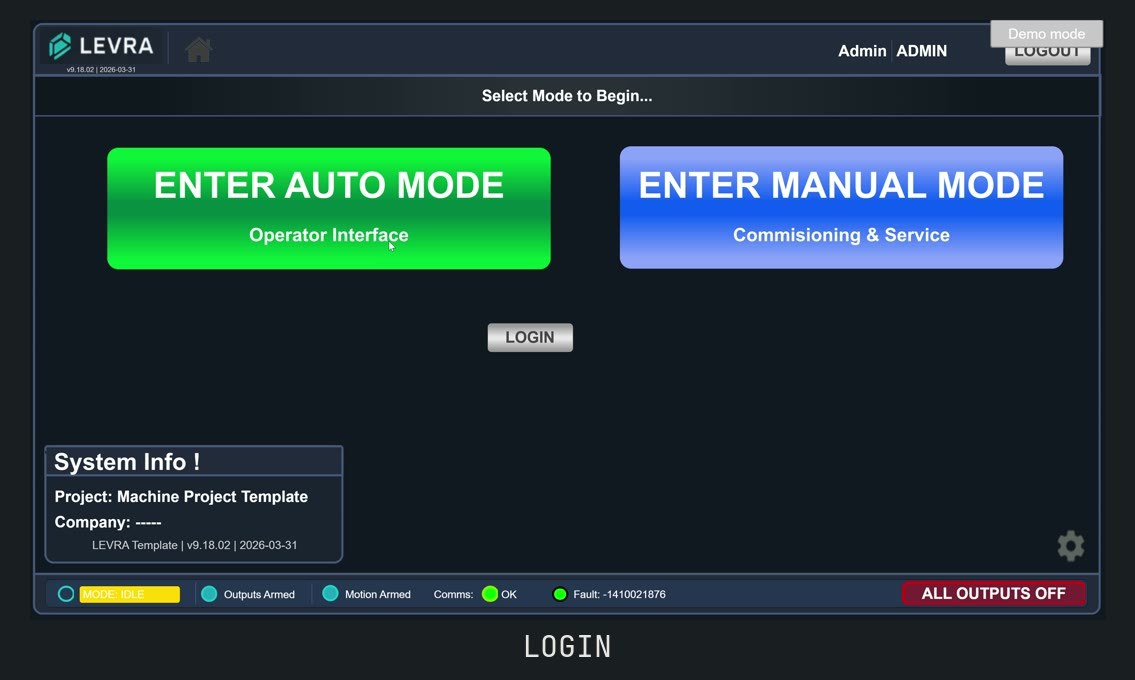
Every Levra machine inherits a proven controls software foundation. Login, operator control, mode management, fault recovery, job tracking, diagnostics, and manual override all ship as a CODESYS template — the same shell on every machine. Machine-specific code (sequences, station logic, recipe handling) plugs into defined insertion points instead of being authored on a blank project.

What ships with every machine

  • Mode management. Auto / Manual / Park / Setup states with clear, operator-visible transitions.
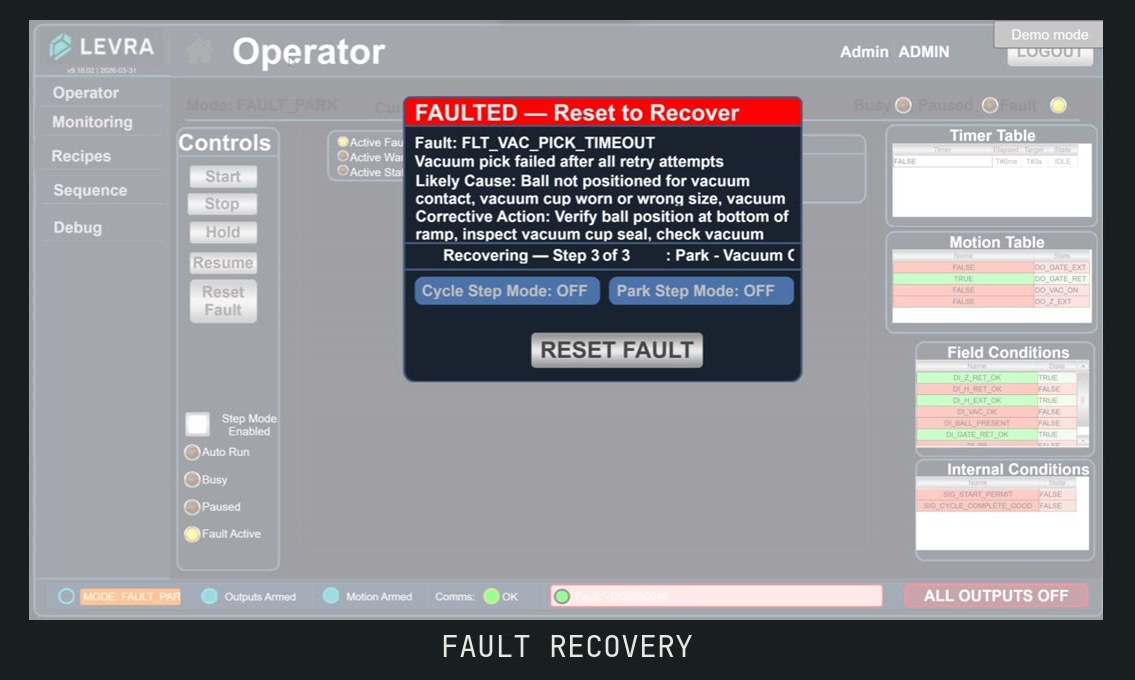
  • Fault popup with structured recovery. Every fault has a code, a likely cause, a corrective action, and a recovery state — operators know exactly what to do when something stops.
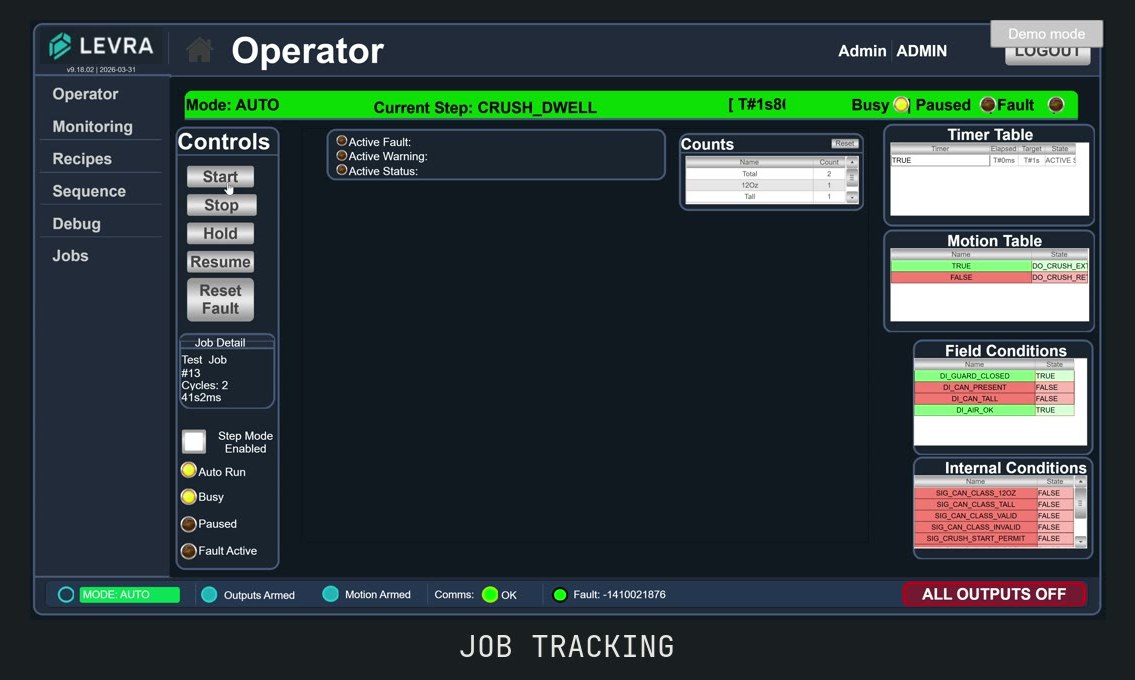
  • Job tracking + always-on telemetry. Cycle counts, runtime, parts per hour, CSV export per job. The event ring keeps recording even outside an active job.
  • Operator login + role-based access. Operators, technicians, and admins each see what they need.
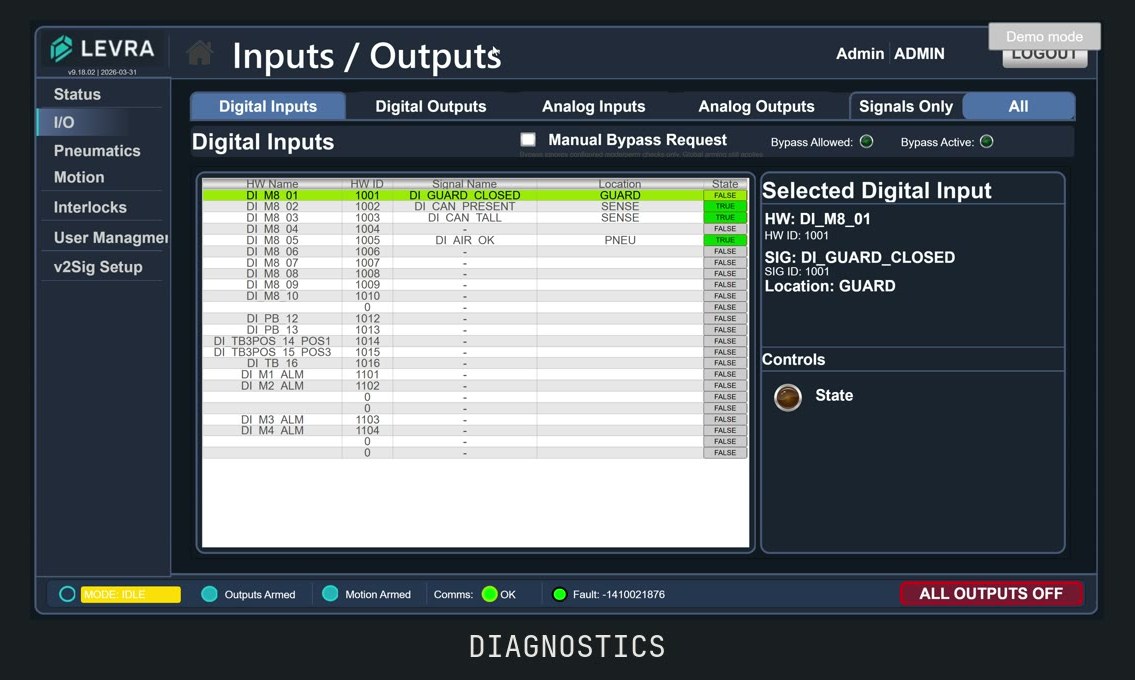
  • Permission engine + standardized diagnostics. Every output flows through a unified interlock check. When something won’t fire, the HMI tells you which condition is blocking it — the same I/O viewer, signal trace, and debug pages on every machine.
  • Step Assist commissioning mode. Walk the machine through its cycle one phase at a time. Essential for bring-up, debug, and operator training.
  • Comms health monitoring. Modbus/TCP with debounced state (300 ms loss / 500 ms restore) and automatic recovery on reconnect.
  • Parameter system with HMI persistence. Operators tune timing, limits, and recipes from the HMI; values persist across power cycles.
Why the template pays off

  • Faster projects. The controls work that’s “the same on every machine” only gets written once. Engineering focuses on what’s actually unique to your build.
  • Operator consistency. A worker who’s run one Levra machine recognizes the modes, fault popup, and job tracker on the next.
  • Quality compounds. Every project finds and fixes edge cases. The next machine starts from the post-improvement baseline.
  • Maintainable by your team. Standardized structure means an outside contractor or our next engineer can pick up a Levra machine and understand its controls.
04 / Fixtures, stations & controls

Stations designed as one integrated system.

Most of the real work in automation is in the fixtures, tooling, and details of how the station actually handles the parts. We design and build complete stations where the fixtures, motion, and control panel are treated as one integrated system — not three separate purchases that have to be made to work together later.

  • Custom fixtures and nests. Make part position obvious and repeatable. Quick-change options for SKU variation.
  • Motion and robot programming. Built around the fixture — clear states, simple recoveries, not fragile one-off code.
  • Control panel design and build. Clean DIN-rail wiring, clear labels, room for future I/O. Technicians aren’t afraid to open the door.
  • Safety integration. E-stops, interlocks, light curtains, and guarding scoped from day one.
05 / Engagement models

Ways we can work together.

From “we should automate this” to a running cell. We adapt to where you are — whether you’re exploring feasibility or ready to build.

Paid discovery & concept

A focused, lower-commitment engagement to define the right problem, the right approach, and a realistic budget.

  • Process walk-through, constraint mapping, operator input.
  • Concept sketches, layouts, and options built around your parts.
  • Budget estimate, timeline, and clear acceptance criteria.

Design & build cells

Full project execution from design through FAT, installation, and SAT for compact cells and stations.

  • Mechanical, controls, and HMI designed as one system.
  • Built and debugged with your parts and agreed test criteria.
  • Install, SAT on your floor, and operator/maintenance training.

Retrofits & optimization

Upgrades and targeted improvements for equipment you already rely on, scoped around fast payback.

  • Controls and HMI modernization for aging equipment.
  • Sensing and data add-ons around existing machines.
  • Cycle-time, reliability, and ergonomics improvements at key stations.
Next step

Walk through a process together.

Share a line, cell, or station that isn’t where you want it. We’ll map the current state, outline options, and be realistic about where automation will and won’t pay off.

Start a conversation See recent builds